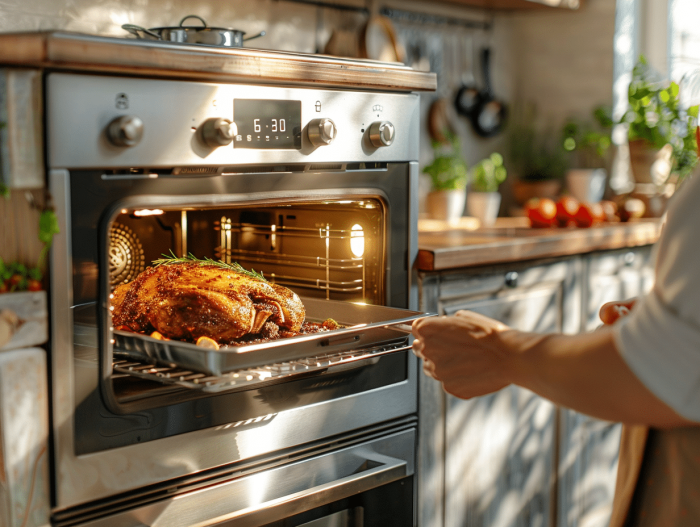
Understanding how your oven’s thermostats correspond to cooking temperatures can transform your culinary experiences. Many recipes specify exact temperatures, but oven brands and models vary in their settings.
Imagine an apple pie: following the instructions for 180°C or thermostat 6 is essential for achieving perfect cooking. However, without a good understanding of these correspondences, the result can be disappointing. Learning to navigate between different thermostats will ensure consistently successful dishes, whether for delicate pastries or juicy roasts.
The equivalences between thermostat and degrees Celsius
To navigate between different cooking temperatures in the oven, you need to understand the correspondences between thermostats and degrees Celsius. Here is a summary table of the equivalences:
| Thermostat | Temperature (°C) |
|---|---|
| Thermostat 1 | 30°C |
| Thermostat 2 | 60°C |
| Thermostat 3 | 90°C |
| Thermostat 4 | 120°C |
| Thermostat 5 | 150°C |
| Thermostat 6 | 180°C |
| Thermostat 7 | 210°C |
| Thermostat 8 | 240°C |
| Thermostat 9 | 270°C |
| Thermostat 10 | 300°C |
Some practical benchmarks
- Warm oven: thermostat 1 and 2 (30°C to 60°C)
- Low oven: thermostat 3 and 4 (90°C to 120°C)
- Medium oven: thermostat 5 and 6 (150°C to 180°C)
- Hot oven: thermostat 7 (210°C)
- Very hot oven: thermostat 8 and 9 (240°C to 270°C)
- Blazing hot oven: thermostat 10 (300°C)
For recipes indicating cooking at 200 degrees thermostat, refer to thermostat 7 for ideal consistency. Knowing these equivalences allows for better control over different cooking processes and helps avoid common mistakes due to misinterpretation of temperatures.
Tips for optimal oven cooking
To achieve perfect cooking of your dishes, a few recommendations are essential. Always preheat your oven to the desired temperature before placing your preparations inside. This ensures even heat distribution from the start of cooking.
Use an oven thermometer to check the internal temperature. Thermostats can sometimes be inaccurate. A thermometer will allow you to adjust the actual temperature and avoid cooking discrepancies.
For certain types of dishes, the position in the oven plays a crucial role:
- Gratins and pastries: place them in the middle of the oven for even cooking.
- Roasted meats: prefer the lower part of the oven, where the heat is gentler.
- Pizzas and tarts: the upper part of the oven is ideal for a nicely browned crust.
Use the convection heat for even cooking, especially for dishes that require consistent and diffuse heat. This function helps distribute heat evenly, reducing cooking times and improving the quality of the dishes.
Avoid opening the oven door frequently. Each opening causes a drop in temperature that can affect cooking. Follow these tips and adapt them according to the specifics of your recipes to ensure optimal results every time you use the oven.