
The peacock’s cry surprises with its power and frequency. Far from being a mere sound ornament related to courtship displays, this vocalization serves several simultaneous functions. Understanding why the peacock cries requires distinguishing the contexts in which this signal is emitted, its acoustic range, and what it provokes in other birds of the group.
Peacock Cry: An Acoustic Signal with Unique Characteristics
Most pages dedicated to the peacock describe its cry as unpleasant or shrill, without going further. The sound produced by the Indian peacock (Pavo cristatus) stands out, however, due to acoustic properties that deserve analysis.
The main cry, often transcribed as a repeated “leon,” carries over long distances. This range is not accidental: it allows the male to cover a wide territory and signal his presence to females outside his visual field. The peacock also emits shorter, deeper vocalizations, less known, which are used during close interactions.
To better understand why the peacock makes its cry, each emission context must be examined separately, as the same species produces sounds whose function varies radically depending on the situation.
Contexts of Peacock Cry Emission: Comparative Table
Ethological studies identify several situations where the peacock vocalizes. The table below contrasts the three main contexts and their respective characteristics.
| Context | Type of Cry | Recipients | Function |
|---|---|---|---|
| Courtship Display (Reproduction) | Loud and repeated calls, often combined with the tail display | Females (peahens) | Attract partners, signal male vigor |
| Alert to Danger | Sharp and brief cries, emitted in rapid sequences | Entire group (males, females, young) | Warn of a predator or disturbance |
| Social Coordination | Lower, less frequent vocalizations | Nearby peers | Maintain contact, react to the arrival of an individual |
This breakdown highlights a often overlooked point: the peacock’s cry is not solely a sexual signal. Reducing this vocalization to the breeding season neglects two out of three functions.
Courtship Cry and Sexual Selection in the Indian Peacock
The Indian peacock serves as a classic case in evolutionary biology. Its iridescent plumage, tail that can exceed two meters, and its cry form a set of complementary signals. The National Museum of Natural History (MNHN) emphasizes that visual and auditory ornaments must be understood together, not separately.
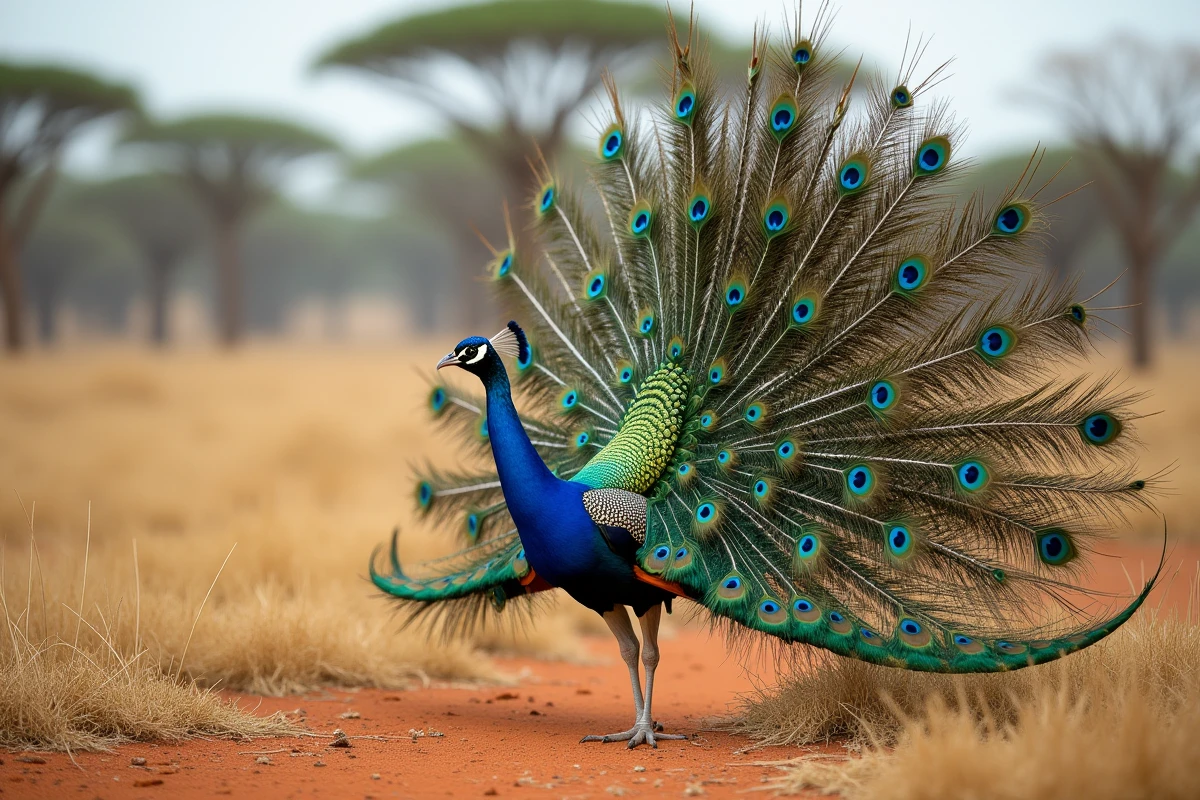
During the breeding season, the male combines the tail display (fanning of feathers) with powerful vocal calls. The tail display alone is not always sufficient: in a wooded environment or when the female is at a distance, the cry takes over to attract attention. The sound signal compensates for the limitations of the visual signal.
When the Cry Precedes the Tail Display
Field observations show that the male often starts by crying before deploying his feathers. This sequence suggests that the cry acts as a first filter: it attracts the female, who then evaluates the plumage more closely. Females that respond to the call move towards the male, saving him the considerable energy required to maintain the tail display.
The cry reduces the energetic cost of courtship by pre-selecting receptive females. This mechanism illustrates the optimization logic that sexual selection promotes in polygamous species like the peacock.
Peacock Alert Cry: An Underestimated Sentinel Role
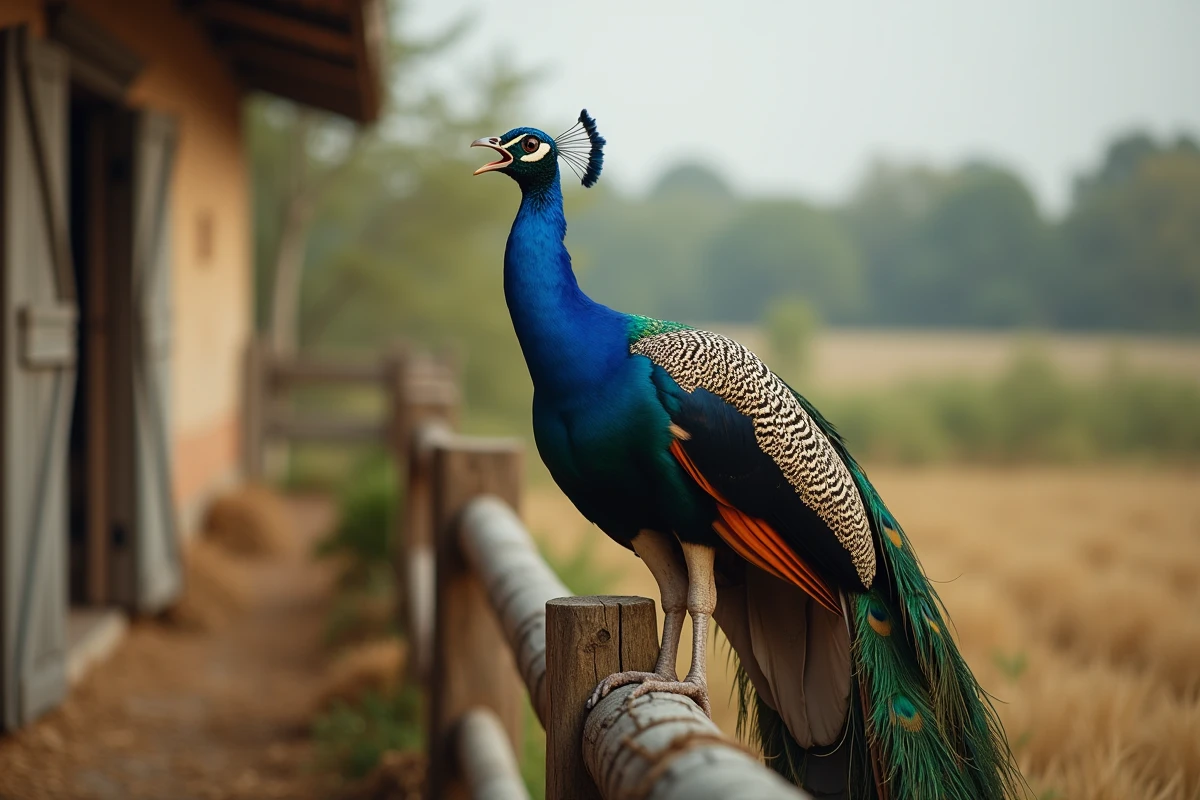
The peacock does not only cry in spring. Its vocal activity also increases in response to disturbances: presence of a predator, arrival of an unknown animal, unusual noise. This sentinel behavior explains why, in certain regions of South Asia (the species’ native range), peacocks have long been kept near human dwellings.
The alert cry differs from the courtship cry in several ways:
- It is shorter and emitted in successive bursts, whereas the courtship cry is long and spaced
- It is produced indiscriminately by both males and females, while the courtship cry is almost exclusively male
- It triggers an immediate reaction in peers (fleeing, freezing, or flying to a perch)
This alert dimension brings the peacock closer to other social birds that use specific cries to signal aerial or terrestrial predators.
Seasonal and Daily Variations of the Peacock Cry
Breeders know well: the peacock is particularly noisy at dawn. This morning vocal peak coincides with the time when the bird leaves its nocturnal perch (often a tree branch) and re-establishes contact with the group.
The annual calendar also modulates intensity. During the breeding season, cries are more frequent and louder. Outside this period, the peacock remains vocal but in a more discreet manner, mainly in response to environmental stimuli.
- Vocal activity peaks at dawn and dusk
- Marked intensification in spring, during the breeding season
- Off-season cries related to social coordination and disturbance reactions
This variability confirms that the peacock’s cry is an adaptive behavior, modulated in real-time according to social and environmental contexts.
Multifunctional Signal Rather Than Simple Seduction Cry
The most accurate reading of the peacock’s cry is that of a multifunctional social signal. It attracts partners, alerts the group, and maintains social cohesion. Disassociating these roles means understanding only a fraction of this bird’s vocal behavior.
The Indian peacock, the most widespread and studied species of the genus Pavo, provides a case where the visual and the auditory form an integrated communication system. The feathers capture attention through light, the cry captures it through sound. The two channels complement each other depending on distance, vegetation, and time of day.